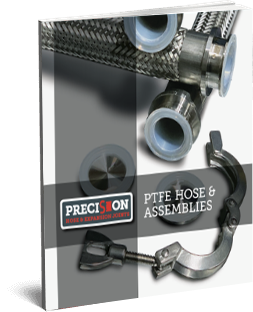
Precision Hose & Expansion Joints has the proven capability of fabricating intricate and highly sophisticated assemblies to satisfy the needs of our customers. A sampling of these quality assured assemblies are as follows:
Why Cleanliness is Critical for Metal Hoses in Data Center Cooling Applications
The Shift to High-Performance Liquid Cooling
- Data centers are rapidly moving toward liquid cooling systems to support AI, high-density computing, and thermal loads.
- These systems rely on closed-loop fluid transfer through:
- Cold plates
- Coolant distribution units (CDUs)
- Heat exchangers
- Metal hoses play a critical role in maintaining leak-free, reliable fluid transfer in these environments.
Why Cleanliness Inside the Hose Matters
Contamination Directly Impacts Cooling Performance
- Even microscopic particles can:
- Clog microchannels in cold plates
- Foul heat exchangers
- Reduce heat transfer efficiency
- This leads to higher operating temperatures and reduced system performance.
Contaminants Drive Corrosion and System Degradation
- Residual oils, weld scale, or particulates inside hoses can:
- Accelerate corrosion
- Create chemical incompatibility with glycol-based coolants
- Contaminants introduce failure points that shorten system life.
Increased Risk of Downtime in Mission-Critical Facilities
- Data centers operate with zero tolerance for failure
- Contamination can cause:
- Flow restrictions
- Pump inefficiencies
- Overheating events
- Even minor fouling can escalate into costly downtime or equipment failure
Particulate and Residue Control is an Industry Requirement
- Cleanliness is not optional—it is engineered into the system:
- Prevents particulate shedding from hose walls
- Maintains fluid purity in closed loops
- Clean internal surfaces reduce nucleation points for:
- Scale buildup
- Biofilm formation
- Corrosion initiation
Sources of Contamination in Metal Hose Assemblies
Typical contamination introduced during manufacturing:
- Lubrication oils from forming processes
- Weld scale and oxidation
- Metal fines and debris
- Handling and environmental contamination
Without proper cleaning, these remain inside the hose and enter the cooling loop.
Precision’s Proprietary Cleaning Approach
Engineered for Ultra-Clean Internal Surfaces
Precision has developed proprietary cleaning processes specifically designed for:
- High-purity cooling systems
- Critical fluid transfer applications
- Data center and power-generation environments
Ultrasonic Cleaning Technology
- Uses high-frequency sound waves to:
- Dislodge embedded particles
- Remove oils and films at a microscopic level
- Reaches areas traditional flushing cannot:
- Corrugation valleys
- Weld seams
- Ensures deep internal cleanliness, not just surface-level cleaning
Pneumatic Cleaning Capabilities
- High-velocity air systems used to:
- Remove loosened debris and particulates
- Dry internal surfaces completely
- Prevents:
- Residual moisture
- Recontamination after cleaning
Multi-Stage Cleaning Process
Precision’s process combines:
- Degreasing / contaminant breakdown
- Ultrasonic cleaning for embedded particle removal
- Pneumatic purging and drying
- Final inspection and controlled handling
This ensures hoses are delivered:
- Free of oils, particulates, and residues
- Ready for direct integration into clean cooling loops
Result: Reduced Risk, Increased Reliability
Precision’s cleaning methods deliver:
- Improved coolant purity
- Reduced fouling and blockage risk
- Extended system life
- Greater confidence in mission-critical environments
Bottom Line
In data center cooling, cleanliness is performance.
A metal hose is not just a pressure boundary—it is part of the fluid system.
If contamination enters through the hose, it becomes a system-wide problem
JACKETED ASSEMBLY
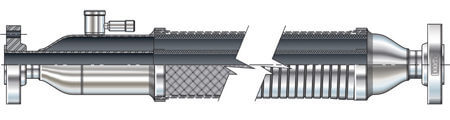
Jacketed assemblies are normally used in one of the following applications:
- As a heated transfer line for those products, such as Sulphur, which must be maintained at an elevated temperature in order to flow readily. Steam or hot oil is circulated through the jacket, which in turn heats the product being conveyed in the core hose.
- As a cryogenic transfer line, maintaining a high vacuum in the jacket effectively insulates cryogenic liquids being conveyed in the core hose.
TRACED ASSEMBLY
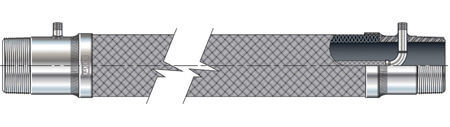
Traced Hose assemblies are used:
When the product being conveyed must be heated in order to flow freely. Steam or hot oil circulated through the inner tracer hose heats the product in order to maintain flow rates.
LINED ASSEMBLY
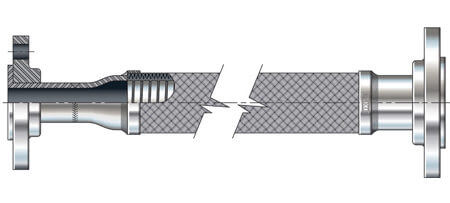
Lined hose assemblies are used:
When high flow rate of the conveyed product could cause resonant vibration in an unlined corrugated metal hose.
GUARDED ASSEMBLY
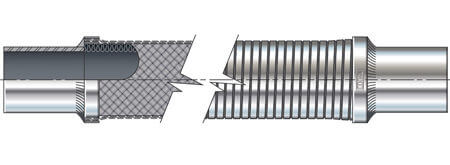
Guarded assemblies are used:
Where a corrugated metal hose could be damaged by rough handling, abrasion, or over-bending.